
The ocean is home to an incredible diversity of microscopic organisms called phytoplankton. Although invisible to the naked eye, these tiny organisms form the foundation of marine food webs, produce much of the oxygen we breathe, and play a crucial role in regulating Earth’s climate. But how can we observe their diversity across the vast ocean? The answer may lie in their colours!
Phytoplankton contain different pigments that help them capture sunlight for photosynthesis. While chlorophyll-a is the most familiar, other pigments, such as chlorophyll-b, chlorophyll-c, and carotenoids, can provide valuable clues about the types of phytoplankton living in the water.
For decades, satellites have allowed us to monitor phytoplankton from space, mainly by estimating chlorophyll-a concentrations. Now, a new generation of hyperspectral satellites is opening exciting possibilities. By measuring hundreds of subtle variations in ocean colour, these sensors may allow us to detect the optical signatures of different pigments, revealing much more about phytoplankton communities than ever before.
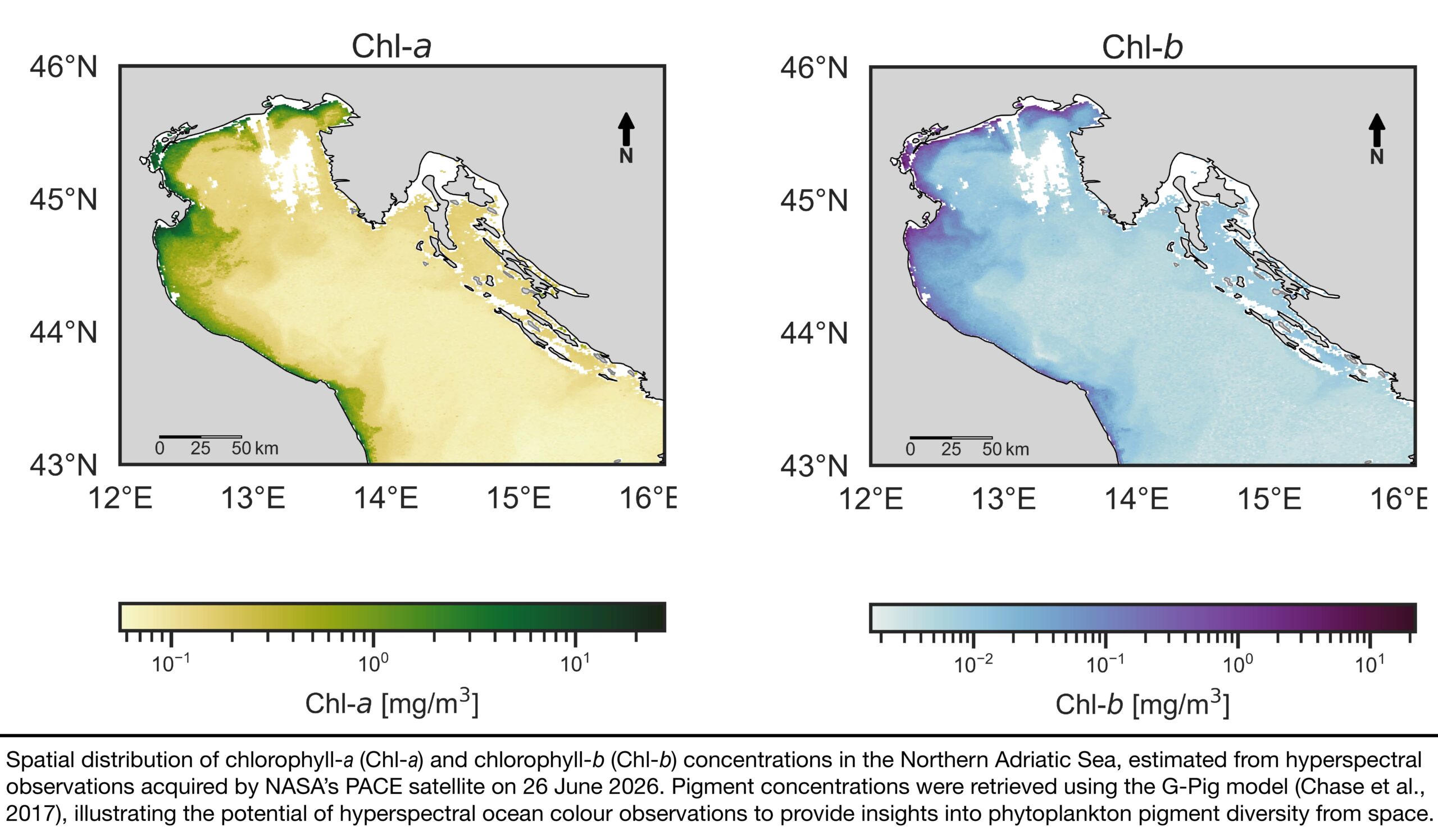
Can we move beyond measuring how much phytoplankton is in the ocean to understanding what types are present?
This is one of the questions we are exploring in the ESA PHYTODIVERSE project.
We are currently testing how accurately different models can estimate phytoplankton pigment concentrations from ocean colour observations. By comparing model predictions with measurements collected directly in the ocean, we aim to understand which approaches perform best, how reliable their estimates are, and what challenges remain in detecting the diversity of phytoplankton pigments from space.