
About Phytodiverse
The Challenge
Phytoplankton form the basis of almost all life in the ocean through their production of organic carbon via photosynthesis. Their biological diversity strongly influences ocean trophic web structure and marine biodiversity distribution. With the advent of hyperspectral satellites, we now have unprecedented capabilities to characterize this diversity from space.
However, developing new algorithms requires abundant in-situ datasets and cannot be accomplished by space agencies alone. This is where PhytoDiverse bridges the gap; aligning with EC-funded projects to advance phytoplankton diversity science and create actionable biodiversity indicators.
Our Approach
Phytodiverse employs a comprehensive four-pillar methodology to transform satellite observations into policy-relevant indicators:
01
Primary Observations
Combining data from ESA Sentinel-2 and Sentinel-3 satellites with hyperspectral PACE data to produce spatially enhanced Remote Sensing Reflectance products. Existing ESA datasets (OC-CCI) provide essential baselines for analysis.
02
Biodiversity Models
Advancing phytoplankton diversity as an Essential Ocean Variable through community composition algorithms that exploit hyperspectral capabilities, combined with bespoke niche-based Species Distribution Models.
03
Essential Biodiversity Variables
Delivering datasets of community composition and ecosystem function based on algorithmic advances, investigating functional traits from pigments and cell size, and ecosystem phenology patterns.
04
Change Indicators
Computing temporal and spatial change indicators from our products, providing critical information for science cases and integration with global biodiversity monitoring frameworks.
Key Innovations
Hyperspectral Data Fusion
Phytodiverse develops innovative techniques to combine multispectral ESA satellite data with hyperspectral observations, achieving enhanced spatial resolution while maintaining spectral fidelity essential for diversity assessment.
Functional Trait Analysis
Our algorithms investigate phytoplankton community diversity from functional traits based on pigment composition and cell size, enabling more nuanced understanding of ecosystem function beyond traditional chlorophyll measurements.
Uncertainty Quantification
Rigorous validation through comparisons with in-situ data, different satellite products, and model outputs ensures reliable uncertainty estimates for all derived products and indicators.
Science Case Studies
Three distinct science cases utilise Phytodiverse products and indicators across different marine environments, investigating phytoplankton diversity succession within and around blooms:
NE Atlantic Study
Examining long-term changes in plankton community structure and ecosystem function, this case study provides insights into climate-driven processes affecting open ocean biodiversity.
Integration with ongoing EC projects enables comprehensive temporal analysis of community shifts and their ecological implications.
Northern Adriatic Study
Focusing on phytoplankton bloom diversity in dynamic coastal waters, this study investigates how environmental variability drives community composition changes.
Enhanced spatial resolution from data fusion proves particularly valuable in heterogeneous coastal environments.
Arctic Study
Investigating phytoplankton diversity in rapidly changing Arctic waters, this case study tracks how warming affects polar marine ecosystems.
Critical for understanding climate change impacts on high-latitude biodiversity and ecosystem function.
Towards Policy Integration
Through this comprehensive approach, Phytodiverse connects various satellite products in a workflow toward meaningful indicators. Knowledge gained from science cases informs a roadmap for future EC-ESA project collaboration, acknowledging both limitations and opportunities.
The project forms the basis for a new European area of collaboration in Ocean Health and Biodiversity, designed for integration with upcoming European and global monitoring systems. By advancing algorithms adapted to novel hyperspectral datasets, we quantify changes in phytoplankton communities and investigate their connections to climate-driven processes both gradual and extreme to inform policy at the global scale.
Looking Forward
Phytodiverse represents a critical step toward operational monitoring of ocean biodiversity from space. By combining cutting-edge satellite technology with robust validation and innovative algorithms, we build connections with ongoing EC projects to guide the next steps in monitoring, understanding, and preparing for plankton changes at the global scale.
Latest Updates
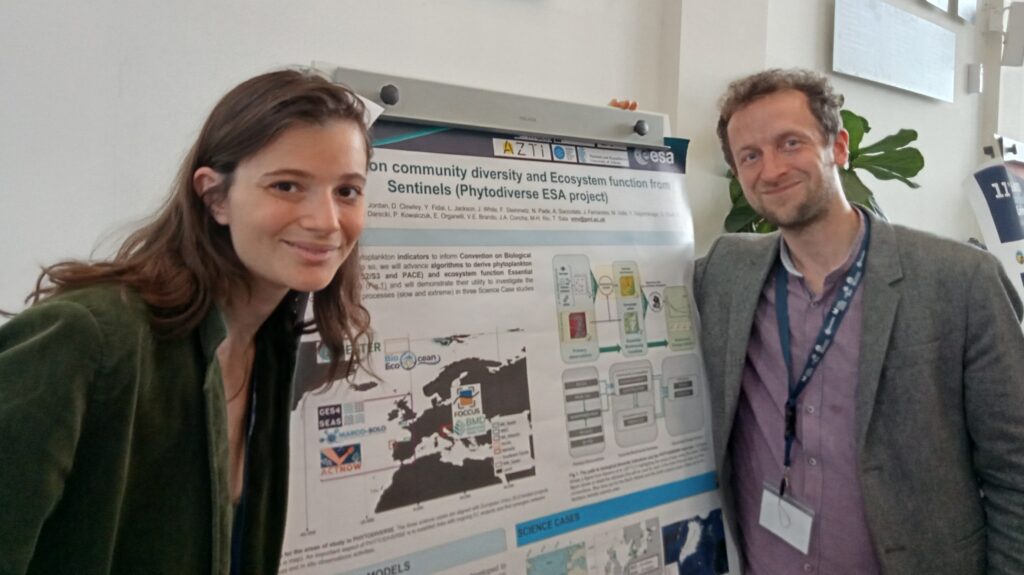
PhytoDiverse Showcased at EuroGOOS 2026
The ESA-funded Phytodiverse project was presented at the 11th EuroGOOS International Conference, “Stronger Together”, held in Larnaca, Cyprus, from 18–20 May 2026.
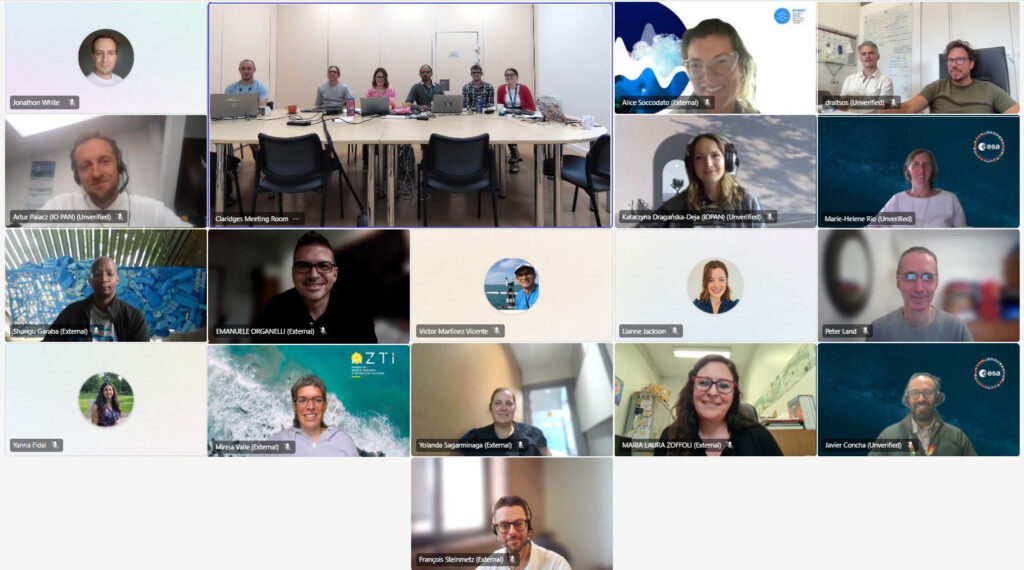
The PhytoDiverse project kicks off
The PhytoDiverse project held its kick‑off meeting last week, bringing together scientific expertise from across Europe to facilitate research for the three‑year, European Space Agency‑funded